A Daily Cleaning List That Actually Works

When a space looks clean at 8 a.m. but feels neglected by 2 p.m., the problem usually is not effort. It is the lack of a practical daily cleaning list. In busy offices, retail stores, restaurants, and shared commercial spaces, cleaning has to support health, presentation, and workflow all at once.
A good routine is not about adding more tasks. It is about assigning the right tasks at the right frequency, with clear accountability. That matters even more in customer-facing environments where fingerprints, restroom traffic, food debris, and garbage buildup can affect how people judge your business within seconds.
Why a daily cleaning list matters
Daily cleaning protects more than appearance. It supports employee wellness, reduces the spread of germs on shared surfaces, helps control odors, and lowers the chance that minor messes turn into bigger maintenance issues. For businesses, it also protects the customer experience. A clean front entrance, stocked restroom, and tidy breakroom signal that operations are under control.
The right list also creates consistency. Without a standard, one shift may wipe counters and empty trash while another overlooks touchpoints, floors, or supply restocking. Over time, that inconsistency shows up in complaints, uneven sanitation, and avoidable wear on the space.
There is also a staffing reality to consider. Most teams are balancing customer service, administration, production, or food handling on top of basic upkeep. A written list reduces guesswork and makes expectations easier to follow, whether cleaning is handled in-house or by a professional provider.
What to include in a daily cleaning list
A useful daily cleaning list should focus on high-impact tasks. These are the items that affect hygiene, safety, and appearance within a single business day.
Entryways and front-of-house areas
Entrances create the first impression and collect some of the most visible dirt. Glass doors should be checked for fingerprints and smudges. Floors near entry mats need attention because moisture, salt, dust, and debris build up quickly, especially in high-traffic locations. Trash near entrances should be emptied before it overflows.
Reception desks, waiting areas, and customer counters also need daily wiping and disinfection, particularly on high-touch surfaces such as pens, payment terminals, door handles, and seating arms. In retail and dealership settings, visual cleanliness matters as much as sanitation because customers are constantly scanning the environment.
Restrooms
Restrooms should never be left to chance. Daily service should include cleaning and disinfecting toilets, urinals, sinks, faucets, counters, stall handles, and door hardware. Mirrors need spot cleaning, floors need mopping, and supplies such as soap, paper towels, and tissue need to be checked and restocked.
If traffic is heavy, once a day may not be enough. That is where businesses need to be realistic. A small office may manage with one full daily cleaning and one supply check, while a restaurant, retail store, or public-facing facility may need multiple touch-ups during operating hours.
Breakrooms and kitchenettes
Shared food areas can become unsanitary quickly. Countertops, sink fixtures, appliance handles, tables, and chair backs should be cleaned daily. Garbage and recycling should be removed before odors develop. Floors should be swept and spot mopped as needed.
This area often falls into a gray zone between employee responsibility and janitorial responsibility. That is where trouble starts. If no one owns the task, crumbs, spills, and bacteria build up fast. A cleaning list works best when responsibilities are assigned clearly.
Workstations and shared touchpoints
In office and administrative spaces, desks may be personal, but common touchpoints are not. Daily cleaning should cover door handles, light switches, shared phones, copier buttons, conference tables, chair arms, and other frequently touched surfaces. For open offices, this is one of the simplest ways to support a healthier workplace.
There is some nuance here. Not every workstation needs a full daily detail clean if employees are actively working at their desks or have privacy concerns. In many cases, the better approach is to clean common surfaces daily and reserve deeper workstation cleaning for scheduled service windows.
Floors
Floors tell the truth about how a facility is being maintained. Dust, crumbs, tracked-in dirt, and sticky residue are noticed immediately, even if people cannot explain why a space feels off. Daily floor care usually means vacuuming carpeted areas, sweeping hard floors, and mopping problem spots or full traffic lanes depending on use.
Restaurants, industrial areas, and retail environments often need a more aggressive daily floor routine than standard offices. Slip risk, food debris, and public traffic make that non-negotiable.
Trash and recycling
Trash removal is basic, but it affects every part of the building. Receptacles should be emptied daily in restrooms, kitchens, customer areas, and any high-use workstation zones. Liners should be replaced, and the containers themselves should be wiped if there is visible residue or odor.
Overflowing trash changes how a space feels immediately. It also creates pest and sanitation concerns, especially in food-service settings.
A sample daily cleaning list for commercial spaces
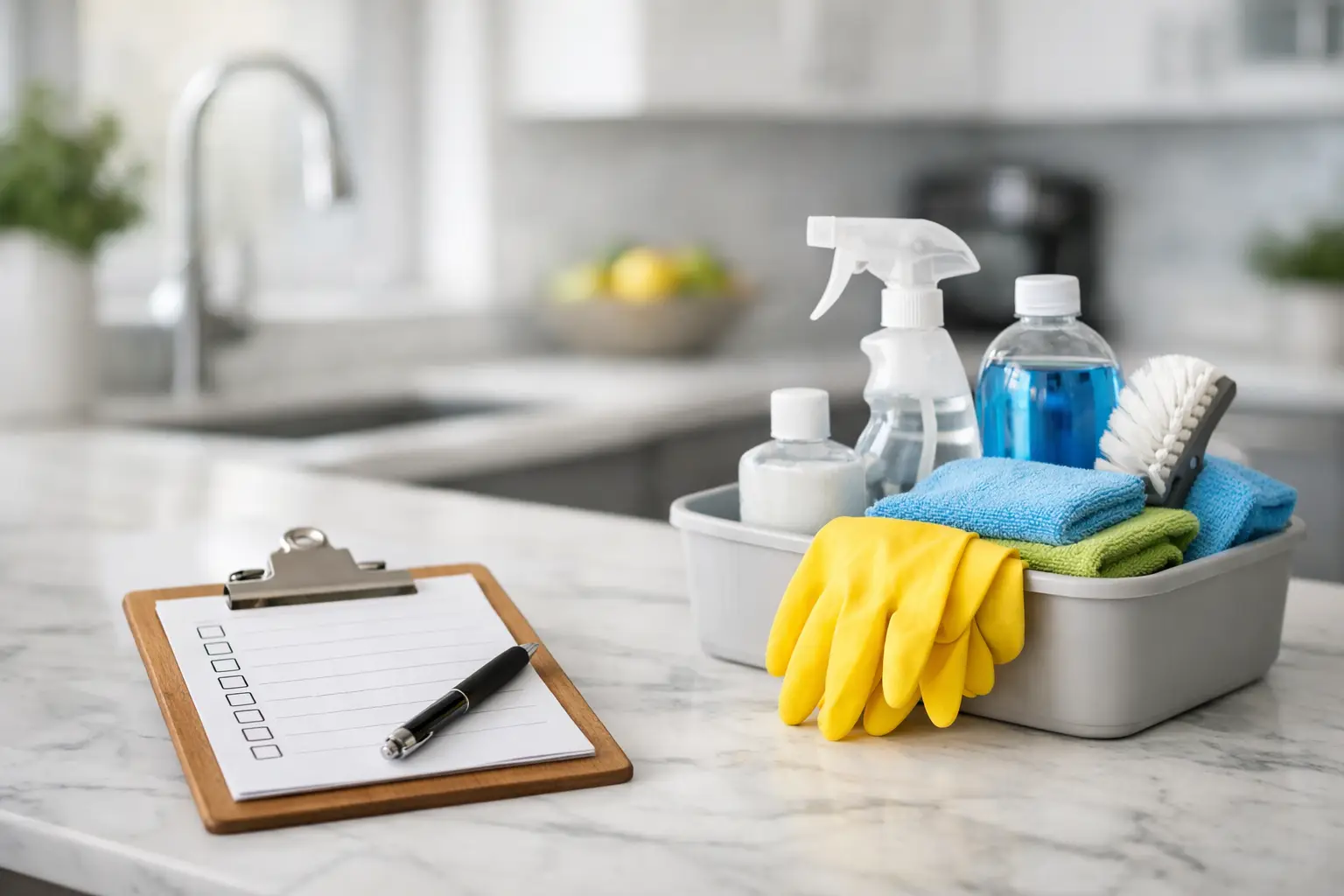
Every facility is different, but most businesses benefit from a checklist that covers the same core areas each day:
- Disinfect entry door handles, push plates, and glass touchpoints
- Clean reception counters, waiting areas, and shared surfaces
- Empty trash and replace liners in all high-use areas
- Clean and disinfect restrooms, then restock supplies
- Wipe breakroom counters, tables, sinks, and appliance handles
- Sweep, vacuum, and mop floors based on traffic level
- Disinfect shared touchpoints such as switches, railings, and equipment controls
- Spot clean walls, mirrors, and glass where marks are visible
That said, a list should never be copied blindly. A medical-adjacent office, quick-service restaurant, auto dealership, and industrial site all have different risks, traffic patterns, and appearance standards.
How to make a daily cleaning list realistic
The best cleaning list is one that gets completed consistently. That means it has to match the facility, the staffing model, and the hours of operation.
Start with traffic, not square footage
A smaller restroom used by customers all day may need more attention than a larger back office used by five people. The same logic applies to entrances, lunchrooms, and sales floors. Build the list around where people gather, touch surfaces, eat, and track in dirt.
Separate daily tasks from periodic tasks
One common mistake is putting everything on the daily list. Baseboards, vents, deep carpet extraction, and high dusting matter, but they are not usually daily needs. When the list becomes too long, teams start skipping the essentials. Daily lists should stay focused on hygiene, presentation, and immediate upkeep.
Assign ownership
Cleaning standards fall apart when tasks are assumed rather than assigned. Whether your business uses an internal team or outsourced service, each task should have a clear owner and timing window. Some items make sense after hours. Others, like restroom checks or lobby touch-ups, may need daytime service.
Build in verification
A checklist only works if someone reviews it. For facility managers and operators, that may mean supervisor signoff, digital tracking, or routine inspections. Consistency improves when teams know quality will be checked, not just expected.
When a custom daily cleaning list is the better option
Some facilities need more than a generic checklist. Restaurants require stronger attention to food-contact adjacent areas, grease-prone floors, and restroom frequency. Retail spaces often need constant front-of-house upkeep and glass cleaning. Office environments may prioritize touchpoint disinfection, meeting spaces, and breakrooms. Industrial settings bring a different set of concerns, including dust control, safety-sensitive surfaces, and workflow coordination.
This is where a customized plan has real value. It keeps cleaning aligned with business operations instead of forcing operations to adapt around a generic routine. For companies managing multiple locations, standardizing the structure while adjusting site-specific tasks is usually the best balance.
For businesses across Toronto and the GTA, HSI Cleaning Services often sees this issue firsthand: spaces are being cleaned, but not always according to how they are actually used. A stronger daily structure fixes that.
Common problems with daily cleaning routines
If your team is cleaning every day and the building still feels inconsistent, the issue is usually one of three things. Either the list is too broad, the frequency is wrong for the traffic level, or no one is accountable for quality.
Supply failures are another common problem. Even a well-trained team cannot maintain standards if disinfectants, liners, paper products, or floor care materials are not stocked properly. Health-focused cleaning depends on process and products working together.
There is also the temptation to focus only on what people see. Visible surfaces matter, but high-touch points matter just as much. A polished lobby does not offset neglected restroom fixtures or shared equipment that hundreds of hands touch each day.
A daily cleaning list should support operations
The strongest cleaning routines are almost invisible. Staff can work without distraction, customers notice the space feels cared for, and managers are not chasing missed tasks or preventable complaints. That is the real purpose of a daily cleaning list. It is not just a cleaning document. It is an operational tool.
If your current routine feels reactive, simplify it, focus on high-traffic areas, and set a standard people can actually maintain. Clean spaces support healthier workplaces, but only when the routine fits the reality of the building.

About Author

Recent Posts
Property Turnover Cleaning That Protects Move-In Dates
8 Insured Commercial Cleaning Benefits for Businesses